
Louisville springs are hard on basements. Heavy rain, saturated clay soil, and Ohio River floodplain drainage can push groundwater against your foundation faster than an older home was designed to handle. If water is reaching your basement floor or your current pump cannot keep up, a sump pump installation in Louisville, KY is one of the highest-value protections you can add before the next stretch.
Our team has spent more than 25 years diagnosing water intrusion across Louisville and Southern Indiana. This guide covers when a sump pump is the right move, how a proper install works, what backup power actually means during storms, and how to avoid the shortcuts that fail in our climate.
Why Spring Rain in Louisville Can Overwhelm Basements
Spring flooding risk here is not only about river overflow maps. Many Louisville homes sit on clay-heavy lots with slow drainage and a water table that rises after repeated storms. Water collects against foundation walls, finds the wall-floor joint, and ends up in the basement.
That pattern shows up across Jefferson County and nearby communities, including homes well outside official flood zones. Poor grading, short downspouts, and older foundations make it worse. Clay soil pressure and moisture behavior also play a role.
A sump pump does not stop rain. It provides a controlled exit for collected groundwater, so your basement is not the system’s low point.
Signs You Need a Sump Pump
Consider a new install or upgrade if you notice:
- Water pooling on the basement floor after rain
- Seepage at the wall-floor joint
- A musty smell or chronic basement humidity
- An existing pump that runs nonstop in wet weather
- A pump with no battery backup that failed during a power outage
- Standing water in a crawl space after storms
- Efflorescence or repeated staining along lower walls
If your home already has interior drainage but no reliable discharge path, the pump is the missing half of the system. If you have a pump but still get water, the issue may be sizing, discharge routing, a clogged pit, a failed check valve, or water entering faster than the current setup can move it. Chronic humidity, musty smells, or standing moisture create prime conditions for microbial growth.
The Sump Pump Installation in Louisville, KY Process
A quality installation is more than dropping a pump in a hole. A typical professional process includes:
- Inspection and diagnosis. We identify where water enters, how much volume you are dealing with, and whether drainage upgrades should pair with the pump.
- Pit location and basin install. The sump basin is placed at a logical low point for collection, often tied into an interior drain system.
- Pump selection. Horsepower, switch type, and pump style should match your water load and pit setup, not a one-size-fits-all model.
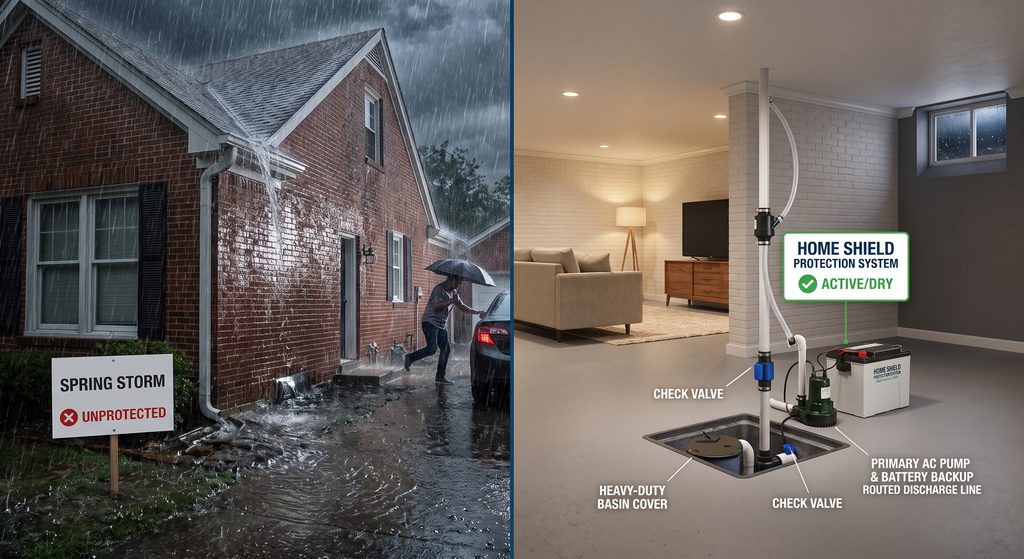
- Discharge line and check valve. Water needs a clear path outdoors to a location that will not loop straight back to the foundation. A check valve helps stop backflow into the pit.
- Testing. The system should be water-tested to verify that it collects, pumps, and discharges correctly before the crew leaves.
Cutting corners on the discharge location or electrical setup is how homeowners end up with a pump that “works” in theory but still leaves a wet floor during a real Louisville storm.
Sump Pump and Drainage: Fixing the System, Not Just the Symptom
A sump pump moves water that has already been collected. It does not replace good drainage design.
In many Louisville basements, the durable solution pairs:
- Interior drainage or a French drain to intercept water at the perimeter
- A properly sized sump pump to discharge that water
- Exterior corrections where downspouts, grading, or surface water are clearly feeding the problem
What Affects Sump Pump Installation Cost in Louisville
Price depends on the scope, not on a single phone quote. Common cost drivers include:
- New install vs. replacement in an existing pit
- Pump capacity and switch type
- Battery backup or secondary pump
- Whether interior drain work is included
- Discharge line length, routing, and exterior exit details
- Concrete cutting, pit depth, and access constraints
- Electrical requirements
Battery Backup and Power Outages
Spring storms knock out power. That is often when groundwater pressure is highest. A primary AC pump alone is a single point of failure.
A battery backup sump pump (or a backup system paired with your primary pump) keeps water moving when the grid goes down. For many Louisville homes, backup power is not just an upgrade for peace of mind. It is part of a realistic flood-prep plan. You could also use a hydro pump, a backup pump that runs off the main water line pressure entering your home.
During your free inspection, we will tell you straight whether backup is strongly recommended for your risk level, rather than upselling every add-on by default.
What to Expect When Working With Home Shield Waterproofing
Our process is built for homeowners who want clarity, not pressure:
- Free inspection and plain-language diagnosis
- Root-cause recommendations (pump only when pump only is enough)
- Upfront written estimate before work begins
- Quality materials and experienced technicians
- Lifetime transferable warranty on qualifying work
- Senior and veteran discounts
We serve Louisville, KY, and Southern Indiana, including Middletown, Anchorage, Prospect, Crestwood, Peewee Valley, La Grange, Buckner, Jeffersontown, and St. Matthews.
Frequently Asked Questions
How long does sump pump installation take?
Many straightforward installs are completed in a day. Jobs that include new interior drainage, difficult access, or major discharge routing can take longer. You will get a timeline with your written estimate.
Can I install a sump pump myself?
DIY kits exist, but it’s easy to get pit placement, discharge routing, sealed joints, and electrical details wrong. A poor install can leave you with the same flooding plus a false sense of security. For chronic water issues or a finished living space, professional installation is the safer route.
How long do sump pumps last?
Lifespan varies with pump quality, runtime, and maintenance. Homes where the pump runs constantly may need earlier replacement. Annual checks before spring are smart, especially before Louisville’s wetter months.
Will a sump pump fix foundation cracks?
No. A pump manages water. Cracks, bowing walls, and settlement need separate structural evaluation. Water control and structural repair often work together, but they are not the same job.
Do I need a sump pump if I already have a French drain?
Usually yes, if that drain is designed to collect groundwater at the foundation. The drain gathers water. The pump removes it. Without one, the system is incomplete in many Louisville homes.
Get Ahead of Spring Flooding
The best time to handle sump pump installation is before the next multi-day rain, not the morning you are moving furniture off a wet floor. If your basement is seeping, your pump is aging out, or you have no backup for storm outages, a free inspection will tell you exactly what you need and what you do not.
Home Shield Waterproofing will inspect your property, explain the cause in plain terms, and provide a clear written estimate. That is how we help Louisville homeowners protect their space through spring and every wet season after.
Ready to prepare your basement for spring flooding? Schedule your free inspection with Home Shield Waterproofing today.