
If your Louisville basement gets damp after every hard rain, you have probably heard someone say, “You need a French drain.” Sometimes that is exactly right. Sometimes you need a different drainage setup, a sump pump upgrade, grading fixes, or a combination. The goal is not to buy a trench. The goal is to stop water where it is actually coming from.
Our team has spent more than 25 years diagnosing basement water problems across Louisville and Southern Indiana. This guide answers the questions homeowners ask most: what a French drain is, signs you may need one, how installation works, what drives a French drain cost in Louisville, KY, and how to tell whether a French drain is the right fix for your home.
What Is a French Drain?
A French drain is a drainage trench that collects groundwater and moves it to a safer discharge point. In basement waterproofing, that usually means a perforated pipe set in washed gravel (often wrapped to limit clogging), placed where water enters or accumulates, and tied into a sump pump that sends the water outdoors and away from the foundation.
Homeowners sometimes use “French drain” as a catch-all for any interior perimeter drain. The important part is what it does: intercept water before it becomes a puddle on your floor, then give it a controlled exit.
Why Louisville Homes Rely on Drainage More Than Most
Jefferson County lots deal with a tough mix:
- Clay-heavy soils that hold water and drain slowly
- Spring storms that dump a lot of rain in a short window
- Ohio River floodplain influence and higher groundwater in parts of the metro
- Grading and downspout problems that send roof water back toward the foundation
- Older foundations that were never detailed for modern waterproofing expectations
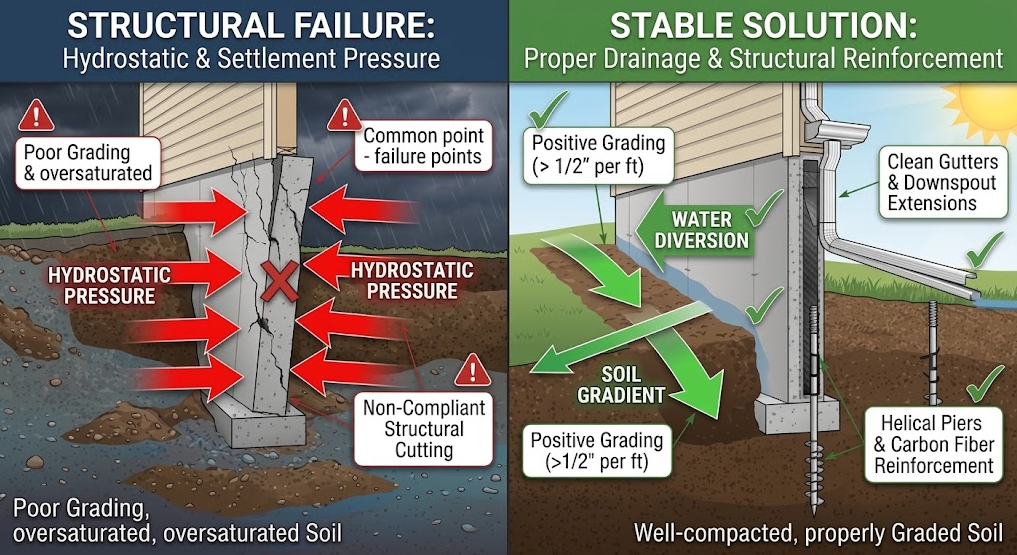
That is why seepage at the wall-floor joint is so common here. Water builds hydrostatic pressure against the foundation, finds the weakest path, and shows up inside.
A French drain does not change Louisville weather. It manages the water that weather drives toward your basement.
Signs Your Basement May Need a French Drain
A French drain is worth serious consideration if you see one or more of these patterns:
- Water entering at the wall-floor joint after rain
- Recurring puddles along one or more basement walls
- Damp carpet, baseboards, or stored items near exterior walls
- Efflorescence (white, chalky mineral deposits) on lower walls
- Musty odor and high humidity that return every wet season
- A sump pump pit that stays empty while the floor still gets wet (water is not being collected efficiently)
- Finished basement damage that tracks back to perimeter seepage
Not every wet basement needs a full perimeter drain on day one. Some homes need exterior grading and downspout corrections first. Some need crack repair, a new sump pump, or crawl space moisture control. Root-cause diagnosis is how you avoid paying for the wrong system.
How a French Drain Works in a Basement System
In a typical interior basement install, the process looks like this:
- Locate the water path. We identify where water enters and where it should be collected.
- Open a collection channel. We create a trench along the interior perimeter (full or partial, as needed).
- Install pipe and drainage media. Perforated pipe and stone create a path for water to move freely.
- Tie into a sump system. Collected water flows to a sump basin and is pumped outside to a proper discharge point.
- Restore the floor and test. Close up the floor, then test the system so you can see collection and discharge working together.
Without a reliable sump pump and discharge line, a French drain has nowhere useful to send water. If your pump is undersized, aging, or missing battery backup for storm outages, address that as part of the plan.
Interior French Drain vs. Exterior Options
Homeowners often ask whether the drain should go inside or outside.
Interior systems are common in Louisville because they intercept water where it enters the living space, usually with less disruption than full exterior excavation. They pair well with homes where water rises at the joint or through the lower wall area after the soil is saturated.
Exterior drainage and waterproofing stop or redirect water before it reaches the wall face. That can be the better long-term path when exterior access is practical and the diagnosis points to outside pressure, failed exterior drains, or grading issues that should be corrected at the source.
What Affects French Drain Cost in Louisville, KY
There is no honest one-price answer over the phone. French drain cost in Louisville depends on the job in front of us:
- Linear footage (partial wall vs. full perimeter)
- Interior vs. exterior scope
- Concrete thickness, access, and obstacles
- Whether a new or upgraded sump pump is included
- Battery backup needs
- Discharge routing complexity
- Whether exterior grading, downspouts, or waterproofing membranes are part of the fix
- Finished basement repairs needed after water damage
A short run that solves a clear, localized entry point costs less than a full-perimeter system with pump replacement and exterior corrections. That is why we start with a free inspection and a written, upfront estimate with no hidden fees.
What a Proper Inspection Should Cover
Before you approve any drain install, the inspection should answer:
- Where is water entering, and why?
- Is this a drainage problem, a structural problem, or both?
- Will a partial system solve it, or do you need full perimeter coverage?
- What happens to the water after it is collected?
- What exterior contributors (gutters, grading, surface drainage) must be fixed so the system is not overloaded?
- What is included in the price, warranty, and timeline?
At Home Shield Waterproofing, that is the standard. We diagnose the cause, explain options in plain language, and only recommend the work your home actually needs. Qualifying work comes with a lifetime transferable warranty. Senior and veteran discounts are available. We serve Louisville and Southern Indiana communities including Middletown, Anchorage, Prospect, Crestwood, Peewee Valley, La Grange, Buckner, Jeffersontown, and St. Matthews.
Frequently Asked Questions
How do I know if I need a French drain or just a sump pump?
If water reaches the floor but isn’t collected efficiently, you may need drainage to gather it and a pump to remove it. If water already reaches a pit and the pump cannot keep up, the pump, discharge line, or backup power may be the weak link. Many Louisville homes need both working together.
Can a French drain fix foundation cracks?
No. A French drain manages water. Cracks, bowing walls, and settlement need structural evaluation and the right repair method. Water control can reduce ongoing pressure and damage, but it is not a substitute for foundation repair when movement is already present.
How long does French drain installation take?
Many interior projects are completed in one to several days depending on linear footage, access, pump work, and whether exterior corrections are included. You will get a specific timeline with your written estimate.
Will installing a French drain make a big mess?
Interior work involves cutting concrete and managing dust and debris. A professional crew should protect living areas, control cleanup, and leave the system tested. Ask any contractor to walk you through protection steps before work starts.
Is exterior excavation always better than an interior French drain?
Not always. Exterior work can be highly effective, but it is more invasive and not always necessary or practical. The best system matches your water path, soil conditions, foundation type, and site access.
Does a French drain help with crawl space moisture too?
Crawl spaces often need their own moisture plan, which may include drainage, a sump, vapor barrier encapsulation, and humidity control. Basement perimeter drains and crawl space systems are related ideas with different details. Ask for a whole-home moisture assessment if you have both spaces.
Get a Clear Answer Before You Dig
A French drain can be the difference between a basement you avoid and a basement you can use. It can also be the wrong purchase if the real problem is discharge routing, grading, structural movement, or a failed pump.
If you are seeing seepage, staining, or storm-after-storm dampness, start with a free inspection. Home Shield Waterproofing will show you where the water is coming from, whether a French drain is part of the answer, what it should cost for your home, and how to protect your space for the long term.
Want a straight answer on French drains and basement drainage? Schedule your free inspection with Home Shield Waterproofing today.