
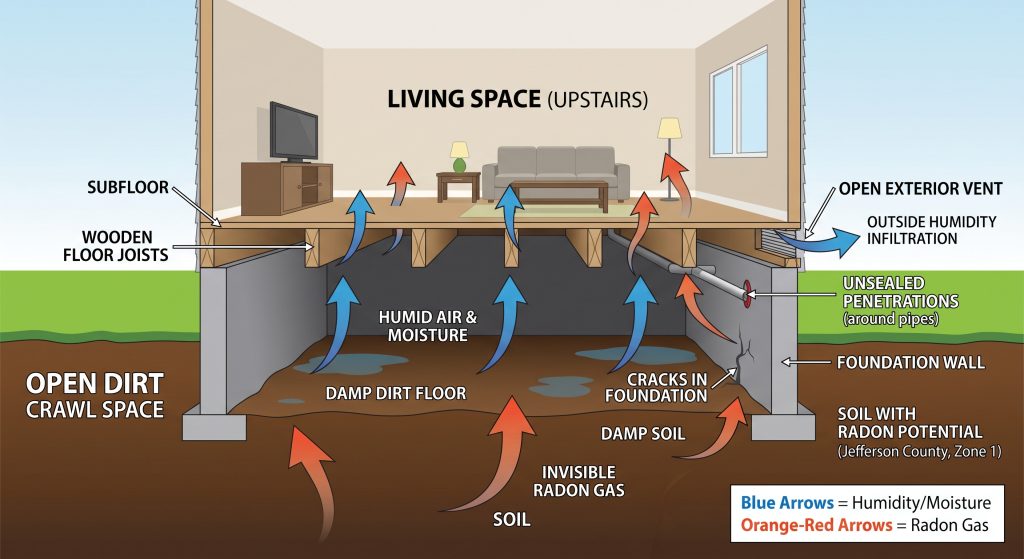
A crawl space encapsulation Louisville, KY, is not a neutral storage area. It is a moisture engine sitting under your living space. Humid air, damp soil, and unsealed vents feed mold, wood stress, and musty air upstairs. In Kentucky, that same unsealed soil is also a common pathway for radon, an odorless gas the EPA links to elevated indoor risk.
Jefferson County is widely mapped as EPA Radon Zone 1, meaning a higher potential for indoor radon than much of the country. Zone maps do not replace a home test, but they do explain why crawl space encapsulation in Louisville is more than a comfort upgrade.
For more than 25 years, our team has been diagnosing below-grade moisture across Louisville and Southern Indiana. This guide covers why local humidity and radon risk make encapsulation worthwhile, what a complete system includes, what it does not replace, and how to decide whether your home needs it.
What is Crawl Space Encapsulation Louisville, KY?
Encapsulation seals the crawl space from outside air and exposed soil. A typical system uses a heavy vapor barrier across the floor and up the walls, sealed seams, closed or conditioned vents, and humidity control with a dehumidifier or conditioned air. Standing water still needs a drainage and sump plan.
Encapsulation is the liner and air-control layer.
Drainage is how you keep that liner from sitting in a pond.
The point is simple: stop treating the crawl space like outdoors. Once you control soil moisture and outdoor humidity, wood, insulation, and indoor air have a much better chance of staying stable.
Louisville Humidity Makes Open Crawl Spaces a Problem
Louisville summers are humid. Clay soils hold water. Spring storms raise groundwater. Many older homes still have vented crawl spaces designed around an outdated idea: letting the space “breathe.” In this climate, those vents often pull in humid air, which then condenses on cooler surfaces. Building Science Corporation and ENERGY STAR both treat a sealed, dry crawl space as the modern approach in humid climates, not venting crawl spaces to the outdoors.
That pattern leads to:
- Musty odors that travel upstairs through floors and ductwork
- Condensation on ducts, pipes, and floor framing
- Insulation that sags, gets damp, or falls away
- Wood moisture that invites mold and long-term rot risk
- Higher strain on HVAC as unconditioned air interacts with the living space
The Radon Connection in Kentucky Homes
Radon is a naturally occurring soil gas. It moves into homes through dirt floors, cracks, gaps around pipes, and other unsealed openings. Louisville Metro public health guidance matches the national message: you cannot smell radon, and the only way to know your level is to test.
The EPA action level is 4.0 picocuries per liter (pCi/L). Many public health sources also recommend taking action between 2.0 and 4.0 pCi/L. Kentucky, and Jefferson County specifically, sit in an elevated radon-potential area on EPA zone maps.
That does not mean every crawl space is over the action level. Ignoring an open dirt crawl space is still a weak indoor-air strategy.
Encapsulation seals a major soil-gas pathway. That is one reason it belongs in a Louisville moisture-and-air conversation, not only a “dry storage” conversation. Encapsulation is not, by itself, a complete radon mitigation system.
If a test comes back high, you may still need a mitigation plan (often a vented collection system) designed by a qualified radon professional.
An honest diagnosis means we will tell you when sealing and humidity control are the right next step, and when testing or mitigation needs to accompany that work.
Signs Your Crawl Space Needs Encapsulation
Schedule an inspection if you notice:
- A persistent musty smell on the first floor
- Visible mold or mildew on joists, box sills, or insulation
- Damp or muddy soil in the crawl space
- Standing water after storms
- Rusted HVAC equipment or sweating ducts
- Buckling wood floors or cupping above the crawl space
- Allergy or respiratory irritation that worsens at home (worth medical advice plus a moisture/air assessment)
- An old vapor film that is torn, unsealed, or only covering part of the soil
A torn 6-mil sheet thrown over dirt is not encapsulation. If the liner is incomplete, unsealed at the piers, or swimming after rain, the space remains open to soil moisture and soil gas.
What a Complete Encapsulation Job Includes
A durable Louisville encapsulation usually includes:
- Inspection and moisture diagnosis. Find standing water sources, grading issues, plumbing leaks, and airflow paths before hanging the liner.
- Water management first when needed. Interior drains, a sump pump, and discharge routing take precedence over a sealed floor if the space floods.
- Cleanup and prep. Remove debris, address obvious biological growth, and prep surfaces so the liner can seal.
- Heavy vapor barrier. Continuous coverage on soil and up the walls, with sealed seams and sealed penetrations at piers and pipes.
- Vent and air strategy. Close the old vent-to-outdoors approach when the design calls for a sealed, conditioned crawl space.
- Humidity control. A correctly sized dehumidifier or conditioned-air plan, with a way to drain condensate.
- Access and durability details. A usable hatch, protected liner in traffic paths, and a system you can still inspect later.
That sequence is root-cause work. Liner over a wet, undrained crawl space is a cover-up with a warranty problem waiting to happen.
What Encapsulation Does Not Replace
Encapsulation is powerful. It is not a magic wrap for every below-grade issue.
- It does not straighten a failing foundation wall.
- It does not replace a needed sump or drain if groundwater is entering.
- It does not guarantee a passing radon result on its own.
- It does not fix roof or plumbing leaks that continue to feed water into the space.
Cost Factors for Crawl Space Encapsulation in Louisville
Price follows conditions, not a generic square-foot slogan. Drivers include:
- Crawl space size, height, and access
- How much water management is required first
- Liner thickness, coverage height, and detailing around piers
- Dehumidifier capacity and condensate routing
- Cleanup, insulation replacement, and debris removal
- Whether radon testing or a separate mitigation design is part of the homeowner’s plan
We do not quote a serious encapsulation over the phone without seeing the space. A free inspection produces a written, upfront estimate with no hidden fees.
What to Expect With Home Shield Waterproofing
Our crawl space process matches the rest of the company:
- Free inspection and plain-language diagnosis
- Water first when water is the real problem
- Quality materials and experienced technicians
- Upfront written estimate
- Lifetime transferable warranty on qualifying work
- Senior and veteran discounts
We serve Louisville, KY, and Southern Indiana, including Middletown, Anchorage, Prospect, Crestwood, Peewee Valley, La Grange, Buckner, Jeffersontown, and St. Matthews.
Frequently Asked Questions
Is crawl space encapsulation worth it in Louisville?
For many homes, yes. Local humidity, clay soils, and elevated radon potential make an open crawl space a long-term problem for indoor air and building materials. Worth it depends on current moisture, access, and whether drainage must come first.
Will encapsulation lower my energy bills?
It can. Sealing and conditioning the space often reduces the amount of humid, unconditioned air interacting with floors and ductwork. Comfort improvement is usually obvious. Energy savings vary by house, HVAC setup, and how leaky the crawl space was to start.
Does encapsulation remove radon?
Encapsulation seals off soil-gas pathways and can support better indoor air control. It doesn’t guarantee radon will drop below the EPA action level. Test before and after major crawl space work, and bring in a qualified radon professional if levels stay high.
Should I leave crawl space vents open?
In Louisville humidity, open vents often make moisture worse. A sealed, conditioned design is the modern approach for many homes. Do not close vents over a wet crawl space without a drainage and humidity plan.
How long does encapsulation take?
A straightforward, dry crawl space can often be completed in a couple of days. Add time when drainage, sump work, heavy cleanup, or difficult access is involved. You will get a timeline with your written estimate.
Can I encapsulate over existing mold?
Do not trap active growth under a new liner and call it done. Assess the space, eliminate moisture sources, and handle contaminated materials appropriately before installing a sealed system. EPA mold guidance treats damp building materials as an indoor-air problem, not just a cosmetic one.
Protect the Space Under Your Home
Louisville crawl spaces fail quietly. Humidity builds, wood stays damp, and soil gas has an open path upstairs. Encapsulation is essential here because the climate and the geology stack the deck against a vented dirt hole under the house.
If your crawl space smells musty, holds water, or has never been sealed, start with a free inspection. Home Shield Waterproofing will explain what your space needs, whether encapsulation is the right system, and how to protect it for the long term.
Ready to deal with crawl space humidity the right way? Schedule your free inspection with Home Shield Waterproofing today.